Blog Archive

Showing posts with label misc. Show all posts

Monday, March 05, 2012

At the supermarket in Siggiewi, Malta

at JJ's in Siggiewi Malta, learning the basics about Maltese living. This is the fruit-and vegetable section. There are also vans at some places that one can buy fresh vegetables from. An attendat was ready to weigh and mark the fruits I selected, and then he put them all in the same bag. Impressive from a sustainability perspective - use much less plastic that way!
Also, there are no plastic bags to carry home the groceries in! One is supposed to bring one's own bag. I had forgotten mine (I do carry one around normally, got it at New Leaf in Santa Cruz when shopping groceries with Josh and Ariel) so we were given a box to carry in.

Wednesday, July 06, 2011

Lost Garden: Game Design Logs

Dan Cook has written a post on how to document game design work. No wiki, no GDD design-bible,  no blogs, but instead using logs. A high level concept description holding the vision and short daily progress notes documenting design decisions. To each his/her own, but i really like the format Danc uses for the log-notes. Good stuff!

Lost Garden: Game Design Logs

Thursday, March 17, 2011

Hello Kitty Suitcase goes to rest

The time has come for my companion and friend, my Hello Kitty Suitcase to go to rest in a cellar in Stockholm. She holds linens.

I got her in 2005 when I was at guest research period at Georgia Tech, in Atlanta. It wasn't possible to get items shipped from the Sanrio store in Japan to Europe, but they *would* ship to the US, so I took the opportunity.

Here is how she looked when she came to me.
Hello Kitty Suitcase - and it's MINE :)

She has been travelling a lot since then, and never gotten lost. Always there on the band when I land, and has always kept my things safe.

This is how she looks now.
Hello Kitty suitcase to rest

There is crack in her side, and it makes her limp. It is strange how heartbreaking it can be to do such a simple thing as to carry a suitcase to a cellar. Out of proportion. If I could have gotten a similar new suitcase I would have, but they are not made anymore. I don't know what's up with Sanrio these days. Before, one could get really high-quality items, like this suitcase.
I knew I couldn't just exchange my HK suitcase to just anything. It would be preposterous. I can almost hear her from the cellar, "You replaced me...with THAT?". It had to bee good. If it can't be perfect, then at least, make it as good as it gets. I did some muppety-surfing (nerdy obsessed comparison-surfing) and finally settled for Samsonite's latest line, the Cosmolite.

my new suitcase front

As you can see in the picture, I applied a few Hello Kitty Stickers on it. Favorite thick gum-stickers that I have saved for something special. I am perfectly aware that they look pathetic, but they also fall off. So I let them. I just came to Stockholm after a trip to California, and not many of the stickers are left. The new suitcase performed well. There is a pleased sigh from the cellar.

Wednesday, November 12, 2008

The Poetic Principle

I have been thinking. During trans Atlantic flights there is time for that. I just came home from Project Horseshoe in Texas, and being there led me to emphasize some thoughts to the point of this text being written, right now.
I remember when I was sitting by the harbor in Savannah in the autumn of 2005 and a big ship passed by. I felt an instant identification. That is me. I have done like that. I set out a course and I follow it, slowly, steadily. Since 1995 I have been exploring how syntax of program code can be used for story construction. I still do it. I don’t know if I am any closer to an answer, but the course is set. In the end of this year I will be done with my thesis. I might consider a change of course then. Maybe not. Time will tell.
An effect of this has been that I have been using this course as a support when I have made choices, big and small. Other principles, or foundations for choices, have not been as important. I can feel a loss.
So the past months I have been adding an approach. In my thoughts I call it “the poetic principle”. I don’t mean poetry in terms of artifacts of text, but rather in terms the deep meaning that is created by good poetry, high symbolism which is at the same time personal and general. A poetic action, choice, or non-choice, or just the appreciation of a situation is different for all of us.
For me, to add this principle, is to appreciate each situation in poetic terms. To see the absurdity, the unexpected beauty, the quirkiness and the nuances. I ask myself “which is the most poetic choice of action?”.
This approach has not brought any dramatic changes to my actions, nor has it been visible. But it has had a profound effect on the inside. I can’t say that I am dramatically happier, but I feel more like myself. I am having invisible fun, most of the time.

Wednesday, August 06, 2008

LaTeX packages for PhD theses

I have been looking at LaTeX packages for PhD theses, most closely at the Dalhousie package, the Stanford package, and the UCLA package.
Dalhousie and Stanford uses the "plain" bibliography style, which means that references in text are as short as possible as[1]. For such a long text as a PhD thesis it would force the reader to have to continuously search the Bibliography in the end. The UCLA packages givesMore... another type of abbreviation in text, like [Bar03], ie taking the first three letters of the author name and the year of publication.
I prefer the Chicago style, often used in humanities which gives (Bartle, 2003). This can be accomplished by using another bibliography style such as "authordate". In order for this to work one need to let the LaTeX printer have access to the appropriate .bst file, for example authordate1.bst.
If one sticks with using 'authordate' and want to be able to in some cases print out both the name and the year (Bartle, 2003) and in other cases only print the year (2003) one also need to let the system access the style file "authordate1-4.sty".
After some experimenting with the packages the following additions to the main file thesis.tex in the Dalhousie package gave me the functionality is sought:

In the beginning of the file, where packages are imported, add:
\usepackage{authordate1-4}

and in the end, before you refer to your library file, add:
\bibliographystyle{authordate1}


Useful resources:

Examples of bibliography styles

authordate package at CTAN

dalthesis -- Dalhousie University Thesis Document Class

Stanford University latex thesis style file


The UCLA Thesis Style for LaTeX


Saturday, August 02, 2008

Blogging with MS OneNote

Using OneNote for blogging is possible for those that have server space with WebDAV functionality... More...

I use the software OneNote from Microsoft a lot when i work. It has features for documenting what one does in a really nice integrated way. It is useful to remember processes with many steps, where the first time one tries there are a lot of trial and error. Keeping track of the errors is... well since i have the memory of a goldfish: next time i do something I don't need to repeat the errors. I take a massive amount of screen dumps in sequences, so i don't need to write everything down. This way I can keep up the work flow but still be documenting.

OneNote 2007 has this interesting little featur "Blog this". Choosing this option for a onenote page brings up the same page in Word 2007, and it is possible to, with a few simple steps publish it. It works perfectly fine for text, but not so well for pictures.
One need to specify a location (called Image Provider -> Own Server) where the image files can be uploaded to.
It does not work to use Flickr. The Flickr help forums have several posts where users try to work out how to do it, but no solution is posted.
It does not work to specify an account on any FTP server either.
Turns out one need to have access to space on a server that uses WebDAV.

Links:
Microsofts pretty unhelpful support page
Brandon Siegl's post explaining why it is rare someone manages to get it to work.

Wednesday, May 09, 2007

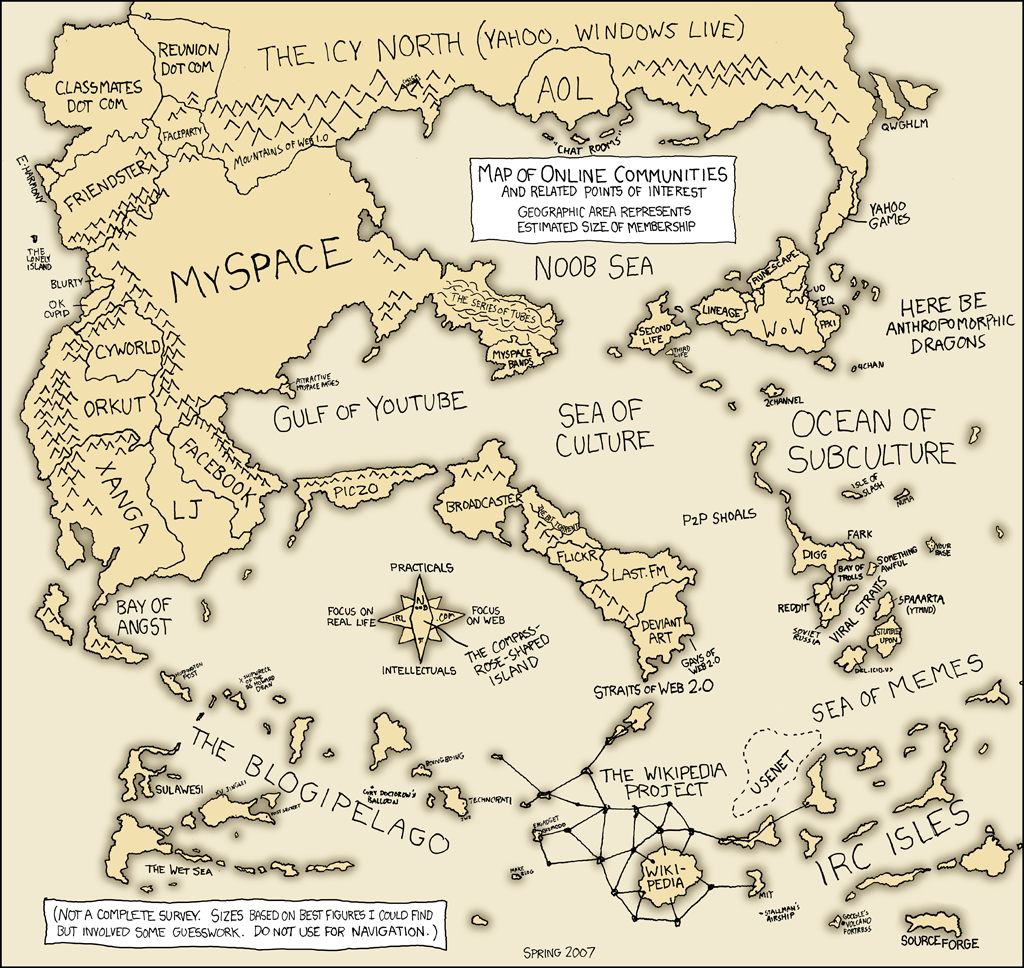
René of the Truants (rouge sholars of MMOs) sent out a link to this wonderful picture today, a Map of Online Communities:


...that made me wonder where we of the Truants may find ourselves. My suggestion is a big truants-shaped cloud formation that stricks down lightnings of pink clarity in seemingly random patterns!

Tuesday, May 08, 2007

The Mystery of the Human Head or The Philosophical Brain


The Philosophical Mind - Fludd
Originally uploaded by mimmi.
For years i have, from time to time, been thinking of a certain picture that I associate with the Mind Module. I have done futile image searches based on key words i thought may give a hit. Today i I stumbled over it while browsing for posters.

The picture is called "The Mystery of the Human Head" or "The philosophical brain", and appeared in a book by the hermetic artist Robert Fludd (1574 - 1632). Utriusque cosmi maioris scilicet et minores metaphysica, physica atque technica historia was published in 1617 (Oppenheim) and came in seven volumes. In the picture Fludd visualizes the spiritual aspects of man as abiding in certain recesses of the brain. The illustration is made by Merian. After som searching i found a picture of a microfilm that has a high enough resolution for seeing what is written in the illustration. Finally! A four year long curiosity is satisfied.


Sources:

Wednesday, January 31, 2007

Swedish embassy in Second Life


reuters-headlines-SL-070131
Originally uploaded by mimmi.
So here i stand, at the Reuters island in Second Life, reading about that "Svenska Institutet" - The swedish Institute, will open an information office in Second Life! It will be a 3d copy of the office in Washington, the architect have given permission to use the prints for building the 3D variety.
Applauds to the Swedish Institute!

Sunday, January 21, 2007

WoW addons, memory note

After having created my new Blood Elf and gotten used to the remarcably lower frame rate of the Burning Crusade, i decided to look over what addons to use now.
Ill try the following set up:

Chatlog, for logging of conversations to text file.

ImmersionRP, for making role playing easier. ImmersionRP also makes it possible to hide all parts of the interface exept for conversation and emotes in text.
Im note sure if it is better or worse than the other two popular RP addons, FlagRSP2 and MyRolePlay, but ill try it.

Titan Panel, to get useful things like the coordinates of my character.

WoWScrnShot_012107_185055

Saturday, November 18, 2006

Dirge of Cerberus


Intro cut, Dirge of Cerberus
Originally uploaded by mimmi.
...is too tricky to play in Japanese. I must find an English copy when i get home to Sweden. I saw Advent Children the other evening (late, i know), and agree with most of the reviewers that it is mainly a fan service, but as such, excellent.

Fun and/or poetic - Bablefished emails

I regularly check the emails that are sent in Japanese to the whole lab with bablefish. I don't need to do it - all that concerns me is sent in English, but i enjoy to see the translations. Some become like poetry, others, like this become downright weird an funny. I mean, look at this:
"The rubbish throwing away of student quality was done. It has left with the way, annoyance we applied."

Birthday dinner for David Gavilan


(testing picasa) Posted by Picasa


All pictures

Monday, October 10, 2005

methods in game research

Looking at game research as a research field, what methods are used?

What types of claims are made?
Conceptual/practical? Other types?

What types of reasons are provided to support the claims made?

What type of evidence is used to support the reasons and the claims?

I see that especially the types of evidences used differ between researchers as individuals depending on what field they come from when entering the field of game research.

To take myself as an example I'm trained in humanities. I tend to, if i don't reflect over my method, to go back to that one. I use quotations, anecdotes etc. Since i also have a training in behavior science i sometimes lean to statistics and to fine grained descriptions of behavior, and sometimes statistical summaries of behavior. Having spent some time in the field of computing science i also lean towards types of claims that are more practical, i.e. focused on finding methods for solving problems, while what I'm trained in is to make more conceptual types of claims. And I have this constant feeling of knowing too little.

I can see that my fellow researches do something similar. Craig Lindley for instance tends to use networks of principles, inferences and implications that sometimes are independent of factual data - as in philosophy. It is either that or the computing science type of claims, if there is time to base the results in evidence from practical implementations and tests of the results of the implementations.

I see that researchers like TL Taylor and Nick Yee basically adopts the methods from sociology and anthropology while researchers such as Nicholas Rajava lean on quantitative data gathered in laboratory experiments.

The DIGRA conference in Vancouver this summer was a terrific expose of different kinds of methods for supporting reasons with evidence.

It is not uncommon that researchers in the game research field make sure to publish in venues of other disciplines as well in order to get validations from other sources.

For my own sake i realize the importance of finding the "right" way of supporting my claims, depending on the current claim. Of course - this is so obvious that its almost ridiculous. But still. No matter how obvious it might seem i think i will revisit my research plan. What if i overlooked something? What if i took something for granted which is not?

This spring we will organize a PhD course at Gotland University where we look at research methods specifically from the point of view of the game research field. I guess we need to take one step at a time and try to be as brave as we can.

Wednesday, September 28, 2005

Not Lost in Space, talk by Lisa Yaszek

Not Lost in Space:
Scence and Technology as Women's Work in Postwar Science fiction
Lisa Yaszek, LCC, 27th September 2005, Georgia Tech.


I went to a very interesting open lecture today. Lisa Yaszek, who started the Science Fiction Lab (http://sciencefictionlab.lcc.gatech.edu/index.html)
at LCC at Georgia Tech spoke about science fiction written by women during the cold war. The fear of a nuclear war was then very real, and women worked outside the home, getting professional careers. Common themes in the fiction was how to survive and cope after the third world war, and how to balance a professional career with having a family.
Yaszek showed how these authors actually offered (fictional) solutions to these problems, that were of great immediate importance at the time. Dystopias, radical and often absurd and scary components.
She also punktures the myth that it was mostly male authors who established the genre in the fifties: During her research Yaszek found a lot of texts by female authors. Forgotten, as it seem to be in most genres.
What i found most interesting was Yaszek mentioned in the end of her speech; of identifying narrative structures in fiction written in times of change.

Some notes i threw down during the speech:

(the title "not lost in space": a tv series from 1960ies)

Dr Maureen Robinson: Scientist and Austronaut.

At these times, frequent theme of how women would cobine professional work with mother-role. Coiche between children and career. (showing a hilarius picture)

Yaszek found a lot of female post war writers creating "galactic suburbia" Wimens love, life and work.
Creating fiction where females escape the fate of Maureen Robson. They do work professionaly, but in a 'female' way; caring.

New patterns in society: domestic mashines that females use. Sowing mashines etc.

Postwar rapid domestic industrialization.

...women as cold warriors at home, bombshelters etc. Displays pics from Life Magasine 1959. Civil defence.

Radical motherhood. Women strike for peace - group.

//speaks extremely rapidly.

Explanation of why Soviet won the space race: they had both male and female technoscientists. NASA started a women in space program, which however didnt stay active for very many eards (till 1962)
Jerri Cobb.

Two story types
Nuclar war stories. -> towards barbarism from civilization or vice versa. Surviving world war III


Judith Merril 1923 - 1997
Mutated children. Setting in post war japan. Nuclear family with disabled child.

Alice Eleanor Jones
At the time:
Female peace movement.
Adjusting to a future with a nuclear war. As a reality.
Reason for survival: government having gene program. Loveless marrigies and children taken away at age of 3. Getting bonuses for children... Lending out childen to childless neighbors. Female protagonist wanting to kill the husband.

Carol Emshwiller (b 1921)
Family depicted have survived world war III. The son disabled, can only communicate through violence. Couple loving each other. Risky to have a child: mother might die. Loose-loose situation.

Authors explore: What would happen to women and theri families in the prospect of WW III.

Solutions?

"Shadow on the Earth" 1950 by Judith Merril.
Men and women working together, striving in the radioactivity. Gladys transforms from helpless houswife through allying with other women. Vita, Galdys, Eve cluster to protect children.
Partial solution: allying with scientists. The men, who have been outside, die of radioactivity. Makes a strong case of peace activity in the present.
Embracing the domestic realm.

Marion Zimmer Bradley. The wind people
Female officer: choose ship or child. Stays on an ailien planet with her son Robin. Who's father might be one of the wind people, the natives on the alien planet. Insestious theme, ending in death.

So how make a situation where professional work doesnt result in death and disaster?

Katherine MacLean (b1929)
Frankenstein. Madness. Female protagonist gives herself body of an 18 year old. Insanity, ends in hospital.

MacLean suggests that not only professional relationships are important (? I think i missed something here)

Judith Merril: "Daughters of Earth"
Six generations of women are followed as they leav earth. Technoscience society. Can it solve the gender work vs domestic life problem?
The way colonization is done is changed.
Learning to communicate better. "A feeling for the organism"

Myth: male authors created the realm in 1950ies. That the female authors started writing in the 60ies.
Not true.

Dystopian storytelling. Future in terms of disaster.

Z: begin identifying story telling structures that has been written in times of change.
Narrative strategy. ...understand the language of the enemy. Female authors did this. To help ppl think about the war differently.

Question time.
The research process?
...found loads of texts by female authors that she had never heard about.
Used for doing political work.

Reproductive technologies? Mutant childeren...

Wednesday, March 23, 2005

Balloons

IMG_1856
IMG_1856,
originally uploaded by mimmi.
But of course.

Friday, January 14, 2005

Klastrup's thesis now availiable

Lisbeth Klastrup's Ph.D. thesis "Towards a Poetics of Virtual Worlds:
Multi-User Textuality and the Emergence of Story
." is now availiable! I have been so curious about it!

The Ultimate Pessimism

world_philosophies_p_339
world_philosophies_p_339,
originally uploaded by mimmi.
Jenny is reading this book now, and i just _had_ to capture this quote! In one of the Mumin books by Tove Jansson there is this really gloomy character that tags along and whines and carries a big book. Was that book by shopenhauer in Janssons fiction??? I have forgotten!

Sunday, October 03, 2004


Sims 2 Player narration - it works! And players can pulish their narratives for others to read. Here is my little attempt :)

The Dramatic Life of the Katt Family - how they naively fall in love with ailiens and the thrilling consequenses


Sims2 narrative.
ComWorks 040521