Blog Archive

Showing posts with label talk. Show all posts

Wednesday, October 31, 2018

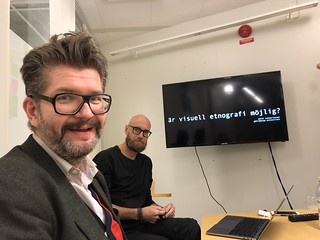
Peter Zackariasson: Is Visual Etnography Possible?

Higher Seminar at the department of Media technology at Södertörn University with Peter Zackariasson.

2018-10-31-zackariasson-HS

Is Visual Etnography Possible? Untitled

Wednesday, October 03, 2018

Jenny Brusk: Inclusive Transmedia Storytelling

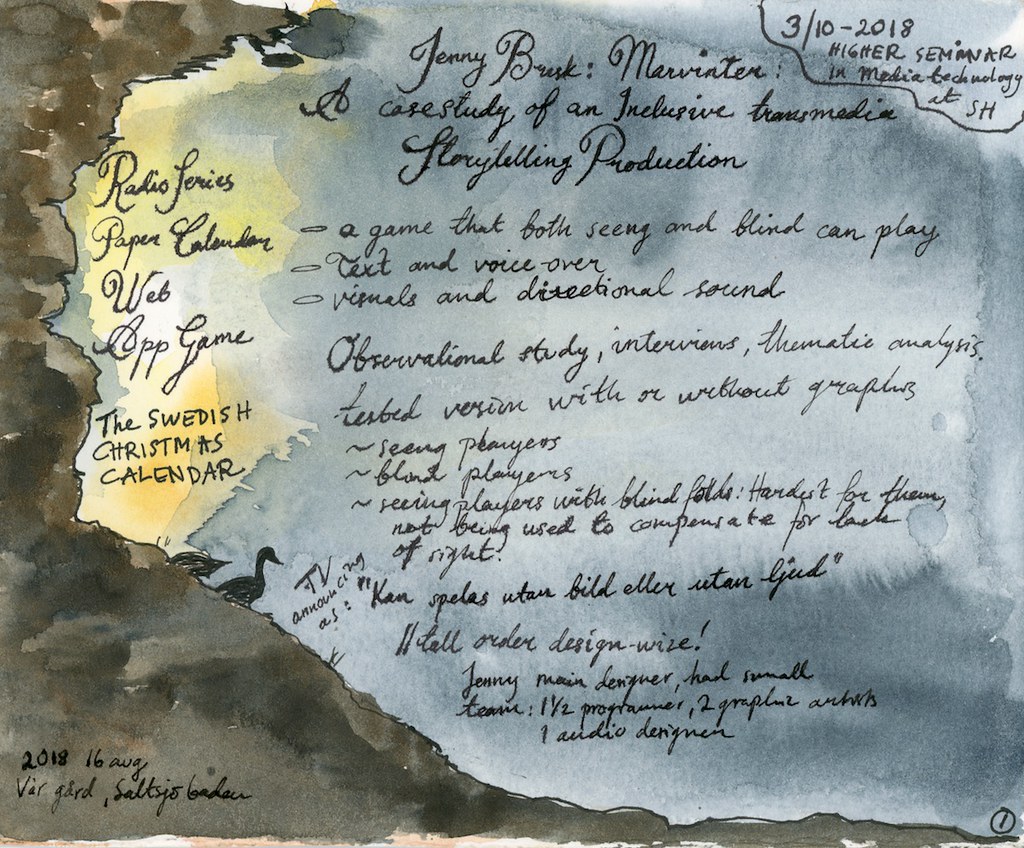
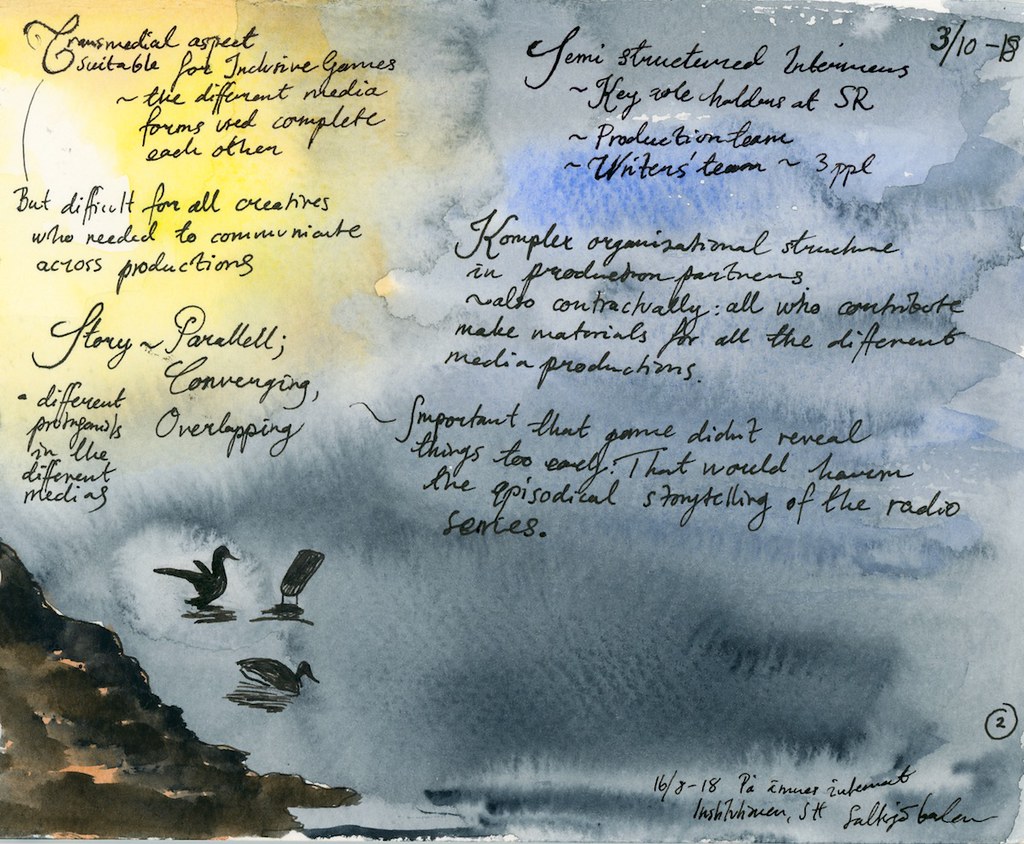
Jenny Brusk was invited to our higher seminar at the Media Technology Department at Södertörn University and gave a excellent talk: "Marvinter: A Casestudy of an Inclusive Transmedia Storytelling Production".

Especially interesting was how the authors needed to work with the different affordances for the different modalities of the narrative; to use either only images, or only sound, but still make it natural for players/readers/listeners who can both hear and see. Impressive!

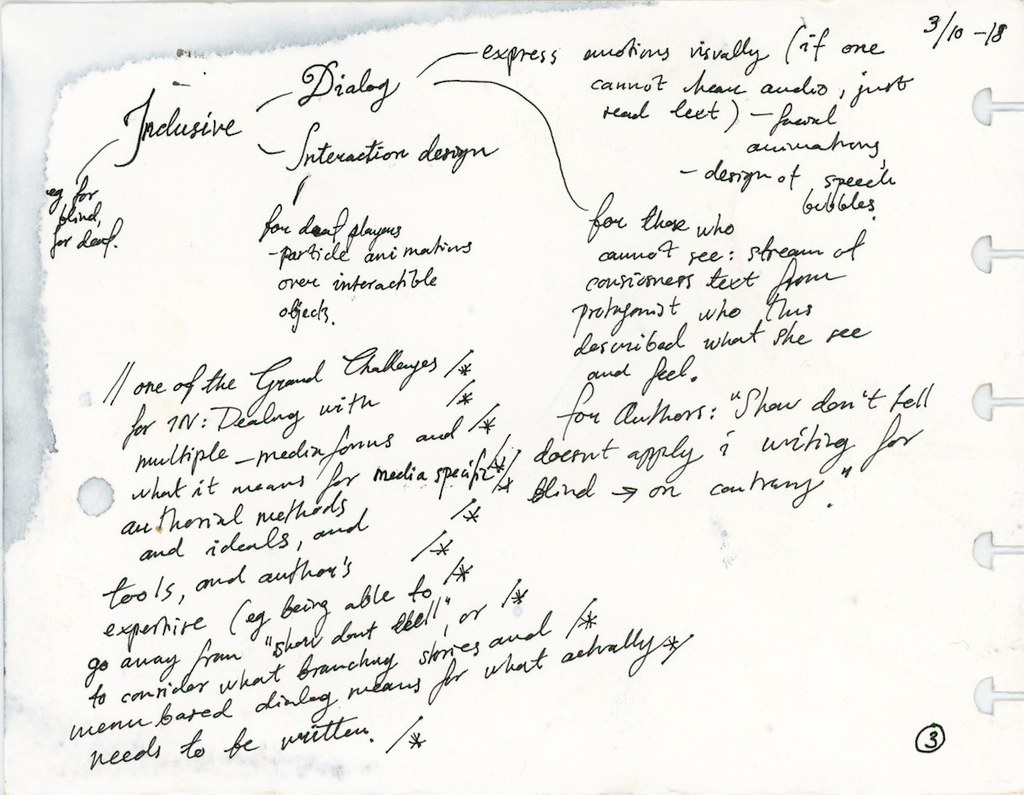
Here are my notes. (I took notes on watercolour backgrounds I had made when the department was away at a seminar a few weeks before, hence the conflicting dates in the images.)

2018-10-03-Brusk-HS-SH-1-w1200px

2018-10-03-Brusk-HS-SH-2-w1200px

2018-10-03-Brusk-HS-SH-3

Sunday, December 04, 2011

Borut Pfeifer on accessibility of game AI by design


Borut Pfeifer came to UC Santa Cruz last Wednesday (30th of November) and gave a talk about how to make sure that all the cool AI made for a game is made accessible to the players.

Borut

The key factors that Borut identified for making the AI accessible to players are
- the complexity of the input that players can make to the game
- the feedback from the game to the player
- the pacing of the difficulty to play and of the dramatic tension in the game.

Borut used the Sims 3 as an example of  good AI accessibility by design: The interface  is simple and intuitive, but still results in complex interesting things in the game, and also allows for more complexity to unfold during continued play. He continued to, in the talk, illustrate the three key factors by showing example from his own development work, mainly from creating the AI for the companion NPC Eve in the development of LMNO, (such a pity the project was cancelled), and from the game he is currently working on, Skulls of the Shogun. I can't wait to play Skulls of the Shogun, Borut's plan for how to pace the dramatic buildup by careful design of the core game mechanics made me swoon a little! It's in development, due in the spring sometime.

Dramatic Systems Design Slide from Borut's talk

Links:


Description of Borut's talk:
http://games.soe.ucsc.edu/events/event/97

About LMNO:
http://www.1up.com/features/story-steven-spielberg-lmno

About Skulls of the Shogun:
 http://skullsoftheshogun.com/

Thursday, November 24, 2011

Clint Hocking on dynamics and meaning in games

Clint Hocking: Dynamics: The state of the art
Clint Hocking, Creative Director at LucasArts, gave a talk at UCSC last week about meaning, dynamics and games. He took a stance in asking HOW games mean (following Chris Hecker) rather than WHAT they mean. "When we know how they mean, maybe then we can speculate on what a specific game might mean."

Clint explained the Kuleshov effect to us, showing how the exact same image takes on different meanings depending on what context it is shown in.

He then went on to talk about Brathwaite's game Train, in the Mechanic is the Message series, where the train cars are destined to the camps of the Second World War. He asked us to close our eyes and play Tetris in our heads pretending that the boxes are train cars. He hummed the tetris music for us.

This was extremely powerful.

Different strategies are possible to obstruct the cars going to their destinations: leave one free spot in each Tetris-row would save as many as possible for example.

By this example he wanted to illustrate how the expression "only a skin" is a reduction when we talk about fictional themes for a game. Changing the fictional theme but not the mechanics of a game is more than a skin because it can change the dynamics of a game, that is, how it is played. (When saying 'dynamics' and 'mechanics' Clint used the terms as used in Hunicke's MDA model.)

Clint's next example was the novel "The Masters of Go" by Kawabata Yasunari that describes a Go match where the game play express the tension between modern and traditional Japan. We looked at the end-state of the game, which was extremely interesting. I think this is one of the best examples one can point at when arguing that not only creating a game can be art - playing games is also a form of art. In this case the art is created by two players together. I remember an anime series I watched when I spent a guest research period in Tokyo - Hikaru No Go - that anime series expressed a similar view on go-playing as art. The perfect game.

Go game illustration L1070235.JPG
Clint argued that it can be difficult to say what the games Tetris or Go mean, but that it is possible to tell what a certain instance of playing the game can mean. Like in our combination of Tetris with train, and in the Go-game described in the Masters of go.

This was one of the best talks I've heard this year, it's up there at the top together with Brian Moriarity's talk at GDC this year. Thank you Clint :)
Lemarchand gave a talk at EIS about the beaty of systems and of risk-taking

Richard Lemarchand
Richard Lemarchand, lead game designer at NaughtyDog, just gave a wonderfully inspiring talk at UCSC. (Talk-description here.) Richard spoke about the beauty of systems and about creative risk-taking, illustrating with evokative pictures and music from games. He referred to two talks that I'll want to check up on, Jonathan Blows talk from GDCE this year about truth and game design (available for free in the GDC vault), and Kent Hudson's talk from GDC'11 on "Player-Driven Stories: How do we get there?" (available at Hudsons website). Richard said so many beautiful things about games, and showed many good examples. I don't think I was alone in the audience in wanting to rush home and make a game once we had stopped applauding him.

Richard ended with a list of practical advice to anyone who is about to make an indie game:
- Don’t listen to people saying it can't or shouldn't be made - Do what you can with the skills you have
- Collaborate, and be persistent
- Say when you don’t know something - people will teach you stuff
- If something needs changing - change it
- Be respectful but direct.
- Be honest, and dare to be vulnerable. (Helps create an atmosphere where it is ok to fail - necessary for risk taking)
- Fail early, fail often.

Wednesday, October 19, 2011

An evening with Brenda and John

Yesterday evening Brenda Garno Brathwaite and John Romero were speaking at the IGDA Silicon Valley chapter. I got a ride with Chris Lewis from the EIS lab over the hill to Mountainview to listen.

Brenda Garno Brathwaite and John Romero

These are my main take-aways:
Brenda: “The rule-set is what separates games from all other art.” Although I have read Brenda’s great book and heard her speak several times i don’t tire of hearing her say this because it is so true. This is the reason why focus on the game mechanics is so necessary.

Brenda and John in a kind of unison: “There *must* be a design lead in a group with several designers. It is great to collaborate in design, but never ever design by committee”. Again, I couldn’t agree more, and in case someone forgets.... just don’t do it, it is so painful.

John: “Fix the second to second game play before you fix the minute to minute.” //boring down to the smallest units of mechanics - I think he means a kind of unit-testing or unit based refinement of game mechanics.

There was a question on how to deal with designers-block, and both John and Brenda were of the opinion that (their) the real challenge is rather to rein themselves in. And that there is always some aspect to work on on a game if another is blocked. Brenda suggested that a block might mean something else: “Games have this way of mercy-killing themselves.”
John: “Don’t name the game in the beginning...don’t force the the name on the game, it will come.

Brenda: Core games will come to Facebook. We can’t ignore that the audience has come to expect certain formats, and games of other types will need to be eased in. //I’m was curious what she’d think about G+ as a platform, but too shy to ask.

About prototyping:
John: I don’t do paper prototyping, I see it so clearly in my head. When the fist version is done I watch players play. It is important to be very quiet, to watch, not interrupt, and write down what the players do. When watching players play Doom and Quake I could see how they would go in certain directions, and I’d redesign and then watch again to see what effects my changes had.
Brenda: I do paper prototyping - I work it in as a milestone. When doing RPGs.


I might have not gotten everything exactly right when I listened - the notes that are not within quotation marks above are not verbatim what was said, it was more what I thought was said as i was jotting down notes.